Thursday, 25 July 2019

10 Important and Useful Mnemonic for Biology Students


Biology is an important and crucial Subject in the medical entrance exams viz., NEET, AIIMS and JIPMER. Biology carries the highest marks and can help medical aspirants excel in their exam if they prepare it well. But the only limitation of Biology is its syllabus, a vast one which requires wider and deeper understanding of many things. Sometimes it becomes really difficult to remember so many terms, definition and details in Biology. Are you too facing this difficulty? We have the solution-MNEMONICS!

Having insight on the common mistakes made by NEET students can help you improve your chances of scoring well in the exam. Read blog – 5 Silly Mistakes toavoid in NEET exam.

A mnemonic is the best shortcut technique to instantly recall the large chunk of information with the help of ONE LINER or Phrase. The purpose of mnemonics is to make learning fun and easy. Here in this article we have presented some easy-to-remember mnemonics for Biology that are sure to give your NEET/AIIMS/JIPMER 2020 study a much-needed boost. Let’s roll on!
1.     Essential Amino Acids

Any Help In Learning These Little Molecules Proves Truly Valuable

A – Arginine                                            
H – Histidine                                                     
I – Isoleucine
L – Leucine
T – Threonine
L – Lysine
M – Methionine
P – Phenylalanine
T – Tryptophan
V – Valine
1     2.Vitamin Table
Tanya and Riya Now are Professors Because Father Cheered

T – Thiamine (vit. b1)
R – Riboflavin (vit. b2)
N – Niacin (vit. b3)
P – Pyridoxine (vit. b5)
B – Biotin (vit. b7)
F – Folic acid (vit. b10)
C – Cyanocobalamin (vit. b12)
     3. Taxonomic Order
Dear King Phillip Come Over For Good Soup 
D – Domain
K -Kingdom
P – Phylum
C – Class
O – Order
F – Family
G – Genus
S – Species


4. Human Genetic Disorders
Alka Sick Thi Phenyl Pine Ce

Alka- Alkaptonuria
Sick-Sickle Cell Anaemia
Th-Thalassemia
Phenyl-Phenylketonuria
C-Cystic Fibrosis

5. Types of WBC (White Blood Cells)

Never Let Momma Eat Beans
N – Neutrophils (60%)
L – Lymphocytes (30%)
M – Monocytes (6%)
E – Eosinophils (3%)
B – Basophils (1%)
6. Phases of Mitosis
I Prefer Milk and Tea
I – Interphase
P – Prophase
M – Metaphase
T – Telophase
7. Stages of Embryonic Development
Zikes! Martin Is A Big Giant Nerd!

Zikes- Zygote
Martin Is A- Morula
Big- Blastula
Giant- Gastrula
Nerd- Neurla


8. Parts of Male Reproductive System
SEVEN UP

S – Seminiferous tubule
E – Epididymis
V – Vas deferens
E – Ejaculatory duct
U – Urethra
P – Penis
This list is just a small example of how little creativity can transform even the toughest concepts into the most interesting one-liners or acronyms. Be innovative and create your own mnemonics. It needs not to be perfect, until it serves its purpose.
Here are four principle which you can follow to make your own memorable mnemonics-
1.      Selection: Select knowledge that lends itself to be turned into mnemonic.
2.     Cue: Use the first letters as the ‘raw material’ for cues.
3.     Chunk: Create a vivid, memorable phrase that reduces the content to a single chunk.
4.     Rehearse: Practise converting the mnemonic to the content to the mnemonic.

So, go on, have fun with your books and make your own list of mnemonics.

Tuesday, 23 July 2019

How to Read NCERT Books for NEET Exam – 5 Powerful Learning Hacks


If you are preparing for NEET exam, then you must be tired of hearing – ‘Read the NCERT textbooks thoroughly.’ However, when it comes to reading NCERT Textbooks, there are some key things to remember. It is not only about what you read but also how you read. Now we are going to discuss some of the best ways to read NCERT books efficiently to grasp the concepts easily as well as from the earliest.
1.      Read line by line: When you are studying for NEET exam, it is important that you read line to line very thoroughly and understand the hidden meaning of it. It’s need to be read more carefully because not even a single diagram-based question is from outside the NCERT books in NEET.
2.     Make Note of Important Topics: While reading you should make a point to highlight the important points or concepts. Do not ignore the illustrations given in the book also as these will help you in understanding the concepts more clearly.
3.     Reading is Just Not Enough: The best strategy to highlight points and make note is to: first read the chapter, solve MTG’s chapterwise NEET questions , check your errors, know important topics of chapters through chapterwise weightage.  In your second reading highlights the terms, lines from which questions in NEET exam have come.
4.     Read From Examiner’s Perspective
Next, you should always move from lower to a higher level or from simple to a difficult question. You should read NCERT books from a teacher’s perspective.
5.     Practice from NCERT Based MCQs
Well, after completing all your reading and revisions of the NCERT texts you should also test your preparation level. Practice from NCERT based MCQs as much as possible.

Monday, 22 July 2019


How to  Read NCERT Books for NEET Exam -  5 Powerful Learning Hacks

If you are preparing for NEET exam, then you must be tired of hearing – ‘Read the NCERT textbooks thoroughly.’ Truly, this can’t be said any better as far as the NEET exam is concerned. You may refer to all important books required for the NEET exams, but make sure you must read the NCERT books of class XI and XII first. These are the most recommended reference books for NEET preparation. However, when it comes to reading NCERT Textbooks, there are some key things to remember. It is not only about what you read but also how you read. In this article, we have discussed some of the best ways to read NCERT books efficiently to grasp the concepts easily as well as from the earliest.

Why NCERT books are required?
Before talking about how to read, let us first understand why you should use NCERT books for NEET exam.
Simple Language: The language used in these books are simple and easily understandable. Also, these books are direct in their approach which makes it easier for students to understand the technical aspects of topics.
Strong Concepts: NCERT books are very good for clearing out the concepts. When these cleared concepts are furnished by proper practice (NCERT Question Bank Link), concepts become stronger.
Direct Questions: Since, NEET authority follows NCERT books for designing of exam, there are many questions which are either directly fetched from NCERT Textbooks orExemplar Books or follow a similar pattern. Numerical based questions are also influenced by the NCERT syllabus.
Having insight about the common mistakes made by NEET students can help you improve your chances of scoring well in the exam. Read our blog PCMB – 5 Silly Mistakes to avoid in NEET exam.
Now, let’s move on to the best ways to read NCERT books for NEET exam
1.      Read line by line
The first thing you should remember is that reading NCERT books for NEET is completely different from reading textbooks in class or schools. When you are studying for NEET exam, it is important that you read line to line very thoroughly and understand the hidden meaning of it. Many questions in NEET exam are directly framed from NCERT Books (Textbook + Exemplar11 th & 12 th). Additionally, the diagrams of NCERT books are very important. They need to be read more carefully because not even a single diagram-based question is from outside the NCERT books in NEET. Also, NCERT books have supplementary material at end of the book. This material is informative, and question can come from this as well.

2.     Make Note Of Important Topics
While reading you should make a point to highlight the important points or concepts. You need to make sure that you go through all the points that are given in every part of the NCERT book. Do not ignore the illustrations given in the book also as these will help you in understanding the concepts more clearly.
3.     Reading is Just Not Enough
The best strategy to highlight points and make note is to: first read the chapter, solve chapterwise NEET questions , check your errors, know important topics of chapters through chapterwise weightage.  In your second reading highlights the terms, lines from which questions in NEET exam have come. Make your notes selectively, this will help to stay focused on important Notes. If you face difficulty to figure out What is MORE important for NEET exam, as for some students EVERYTHING seems to be important, Read from MTG’s Rapid series. It has all important points of NCERT listed for revision.


4.     Read From Examiner’s Perspective

Next, you should always move from lower to a higher level or from simple to a difficult question. You should read NCERT books from a teacher’s perspective. If you do this, it will help you to be tuned with the frequency of question setters. In this case, you can study by adding why, how, what, when, and where before any topic that you study. This is an effective method to study.
What If 30% Efforts Can Get You 90% Scores! Be Smart & Have the List of NEET 2020 Most Important Topics With their Marking Weightage. Go for MTG’s 32 Years Chapterwise Solutions!
5.     Practice From NCERT Based MCQs
Well, after completing all your reading and revisions of the NCERT texts you should also test your preparation level. Practice from NCERT based MCQs as much as possible. For this, you must buy Objective NCERT atyour fingertips, the most trusted and reliable reference book for NEET. It has MCQs extracted and derived from each line, paragraph, diagram, table and data of the NCERT textbook. It has fully solved MCQs of NCERT Exemplar, completing your preparation from NCERT. This is most recommended and hot-selling book series, a must buy in the bucket-list of all NEET aspirants.

These are some productive tips that you must follow to have an effective reading of the NCERT books. If you are looking for some highly resourceful study materials for NEET 2020 then go for MTG’s NEET Resources. The master in turning NEET aspirants into doctors since ages, MTG’s books for NEET are the best-selling in NEET category and most recommended books by toppers and teachers.
Get the Most Authentic MTG’s Resources For NEET 2020 and Prepare Yourself For a Winning Performance.


Monday, 15 July 2019

7 Super Smart Ways to Improve Your score in NEET Mock Tests


Do you wish to improve your score in NEET Mock Tests? Or Are you scoring low in NEET online test series? Here is the solution. The low score in mock test, or series of tests, doesn’t have to demotivate or affect your NEET preparation. You can improve your scores easily by taking few steps in to consideration while attempting the mock test paper or after the completion of it. Here in this article we will tell you the 7 smart ways to improve your score in NEET mock tests.
  1. Analyze Your Test
The most important thing to do after taking a mock test is to analyze it. The test analysis part is more important than taking the mock itself. Just taking mocks is not going to improve your scores. You need to figure out what your personal bandwidth of mistake is, how many errors are from guesses, how many from ‘silly errors’ and how many questions that have been ‘skipped’ were do-able? If you correct these mistakes, would you get the solution? Every step counts so figure out what would do to maximize your score in next test.

  1. Go through its Solutions
Next step is to thoroughly go by the solutions of the mock test. Surprisingly, many students ignore the solutions after giving a mock test, defeating the purpose of the test. So, don’t make the same mistake. GO through the solutions carefully and patiently. While, going through the solutions, you will actually learn the application of theory of problem solving, which is an important skill for cracking NEET exam.
  1. Review the Correct Attempts
Now, start going through the questions that you have solved correctly. Once done, try to look out for shorter methods to solve the questions. Because time management is very important in NEET exam. Learn to do questions in the shortest time possible. This will help you to save enough time for difficult questions.
  1. Review the Incorrect Attempts
Then see the questions that you have solved incorrectly. This is the most important part. Make sure that you never make the same mistake again. Note down the mistakes (conceptual, logical, guess) that you have made and go through them periodically. Seems unimportant but is very helpful, nevertheless.
  1. Solve the un-attempted ones
Now you know all your correct and incorrect questions; the next step is to solve your un-attempted questions. But you should solve these questions by setting a time limit and then analyze them using step 2 and 3. The best way is to practice on MTG online Mock Test series. It provides a detailed analysis of your attempted, un-attempted and correct responses in the best way,to improve your performance and time management skills.
  1. Note down your mistakes
Make a notebook containing your silly mistakes, what went wrong, unnecessary calculations, time spent on solving the question, etc. Identify the key elements in your mistakes and summarize it in your own words. Revise this notebook every time before the next test.
  1. Resolve all mistakes in the same paper
Since this is a mock and you can appear for it again, attempt the mock test paper one more time. You may figure out a new approach this time. Don’t worry about the results. Even if you score low again, it’s fine! Because, by going through all solutions and revising the parts that you got wrong, you are improving your skills, which will definitely help you in the final exam. Practice solving Mock Test Papers from MTG Book series and improve your speed and accuracy to a next level.


To sum up
There is no need to either get overwhelmed with mock scores or to get bogged down by the low mock scores. Follow these ways and improve your score in NEET Mock Tests. Practicing mock test is definitely a very important part of your NEET preparation as it helps you find your strengths and weaknesses out. There are plentiful NEET mock test books available in the online and offline mode. But be careful before buying them! Select only those which are really authentic and reliable. MTG is the most trusted in terms of authenticity and recommended for its originality and quality by toppers and teachers. Its NEET preparation books has been used by NEET Rankers for a long time and gets benefitted. Hence you are advised to go through MTG’s Book series and be NEET ready from the best resource in the market.


If you have any doubts about test strategy or measuring your performance in online mock tests, check out MTG’s NEET online mock test series.

Why Don’t You Try a Free Mock Test? Click here to attempt.

All the best!

Friday, 12 July 2019

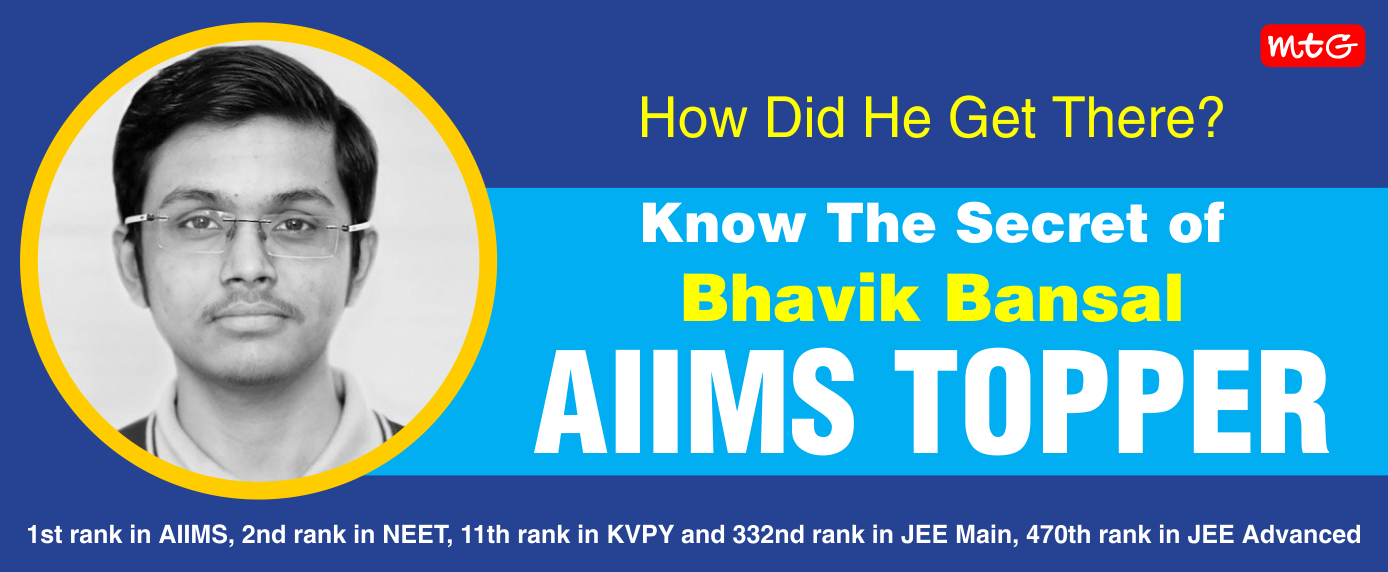
How Did He Get There? Know the secret of Bhavik Bansal-AIIMS TOPPER


The much anticipated AIIMS MBBS 2019 result was declared on 12th June, and top position was bagged by Delhi boy Bhavik Bansal. Being the AIR 1 in AIIMS, AIR 2 in NEET, he was among the 4 candidates that have secured 100 percentile. In the AIIMS MBBS 2019 exam, Bhavik Bansal scored 100 percentile in Physics, Chemistry and Biology and 99.97 percentile in the General Knowledge section. In the NEET 2019 exam, he obtained a remarkable 700 marks out of 720. He claims that though he found the AIIMS entrance test to be more challenging than NEET, he enjoyed solving the AIIMS MBBS paper as the questions tested the aptitude and skills better.
The child of Delhi government employees, Bhavik is the first person in his family to pursue medicine as a career. Aspiring to be a medical researcher, Bhavik Bansal considers NCERT as the Bhagavad Gita for medical preparations.
Let us find out what worked for him and decipher his secret to this marvelous success!

MTG : Why did you choose medical entrance?
Bhavik : It was my mother’s dream to see me as a doctor. Also, I have deep interest in medicine research field as well as Physics.

MTG : What exams you have appeared for and what is your rank in these exams?
Bhavik : I appeared for AIIMS achieving 1st rank, NEET achieving 2nd rank and also 11th rank in KVPY and 332nd rank in JEE Main, 470th rank in JEE Advanced.

MTG : Any other achievements? (Please mention the name of exams and rank)
Bhavik : I have cleared INBO - (217.5/300), InChO - (63.5/106)
I have also attended and cleared level - I and II of OCSC Biology from HBCSE, Mumbai.


MTG : How did you prepare for AIIMS, NEET and other medical exams?
Bhavik : I started my rigorous study and preparation from class - 11th. I studied from NCERT books multiple times. Also, MTG AIIMS Explorer and MTG Objective NCERT at your Fingertips from MTG helped me a lot. Regular and continuous study helped me achieve my aim.

MTG : What basic difference did you find in various papers you cleared?
Bhavik : NEET and JEE, I found based on CBSE syllabus. AIIMS is also NCERT based but the pattern of questions is tougher than NEET and JEE. Focus on Physics and Chemistry numerical is very important as they are lengthy.

MTG : How many hours in a day did you study to prepare for the examination?
Bhavik : My focus was on having my concepts clear for which I would spend even 10 hours at a time. A regular study of 5 to 6 hours was a part of my schedule.

MTG : On which topic and chapters you laid more stress in each subject?
Bhavik : Physics - Semiconductor
                  Chemistry - Organic Chemistry
                  Biology - Genetics and Biotechnology
Practice Physics questions without options, focus on NCERT Exemplar and on questions from Practical Chemistry.

MTG : How much time does one require for serious preparation for this exam?
Bhavik : I would suggest a regular study of 5 to 6 hours a day.

MTG : Which subject/topics you were strong/weak at?
Bhavik : Physics (Weakness) - Wave, (Strength) - Mechanics
                   Biology (Weakness) - Taxonomy (Classical Biology)
                  Chemistry (Strength) - Inorganic Chemistry

MTG : Which Books/Magazines/Tutorial/Coaching Classes you followed?
Bhavik : I took two years’ coaching from Aakash Institute. I followed NCERT books, previous year papers  and MTG AIIMS Explorer  and MTG Objective NCERT at your Fingertips.

MTG : In your words what are the components of an ideal preparation plan?
Bhavik : The main components are studying NCERT multiple times till your concepts are clear. Solving previous year papers  and test series is also very helpful.

MTG : What role did the following play in your success:
      (a)    parents
      (b)    teachers
      (c)  school
Bhavik : My parents always, only motivated me and never pressurized me to do anything. My teachers at school and at my institute also helped me in clearing my doubts and being there for me.

MTG :  Your family background?
Bhavik : My mother is a PGT Physics teacher in a Govt. School, and my father is Senior Accounts Officer in Delhi Govt. My brother is pursuing Economics (Hons) from Ramjas College, DU.

MTG :  What mistake you think you shouldn’t have made?
Bhavik : One should rely only on NCERT books for clearing their basic concepts rather than other books or institutes. For practice, once your concepts are clear, other books and institute will be of great help.

MTG :  How did you de-stress yourself during the preparation? Share your hobbies and how often could you pursue them?
Bhavik : To refresh my mood I used to watch English movies and stand-up comedy shows.

MTG : How have various MTG products like Explorer, Books and Magazines helped you in your preparation?

Bhavik : I have used MTG AIIMS Explorer and MTG Objective NCERT at your Fingertips. Also I used to solve questions from CBSE Drill and NEET Ready from MTG Magazines (Physics - Chemistry - Biology - Maths)


MTG : Was this your first attempt?
Bhavik : Yes, first attempt.

MTG : What was your exam strategy?
Bhavik : My exam strategy was simple. I started answering the paper with Physics but found the questions to be lengthy, so I switched to Biology which was much easier and NCERT based. I completed the Biology section in 30 minutes and then finished the rest of the sections.

MTG : Had you not been selected then what would have been your future plan?
Bhavik : I would have opted for IISc graduation if not selected.

MTG : What do  you think is the secret of your success?
Bhavik : According to me, if you like a subject and enjoy studying it, you will never feel burdened by it. I used to take questions as challenges and solve them.

MTG : What advice would you like to give to our readers who are PMT aspirants?
Bhavik : NCERT is must for NEET. In AIIMS 80-90% Biology questions are asked from NCERT. For Physics and Chemistry, practising higher level questions along with NCERT is also required. I would strongly like to suggest aspirants to focus primarily on NCERT for multiple readings, and regular and continuous study is the key to attain success.


Cracking AIIMS is no easy game, it takes a lot of efforts, time and determination to pursue your dream without giving up! To make you fully aware of AIIMS Exam and to introduce you with right resources that will give you the best result, we have listed detailed information about AIIMS exam.  Click on below:

AIIMS 2020-Everything you need to know to give as exceptional performance as Bhavik Bansal


How to Solve Difficult Problems in JEE and NEET

“Doing the best at this moment puts you in the best place for the next moment.” -Oprah Winfrey This article is specially to encourage ...